
Overton County Criminal Court Cases
Overton County sits in Tennessee's 13th Judicial District. General Sessions Court hears misdemeanor prosecutions and the early steps in felony matters. A felony can begin there with an appearance, bond ruling, and preliminary action before waiver or bind-over and grand-jury review move it to Criminal/Circuit Court. The Circuit Court Clerk serves the county's Circuit, Criminal, and General Sessions functions. That office preserves the case number, pleadings, docket events, judgment, sentence, costs, and later filings.
Livingston Municipal Court occupies a narrower lane. It handles city ordinance and traffic matters within its lawful reach, not Overton County felony prosecutions. Start with the court named on a citation, warrant, bond paper, or prior notice. If the document is unclear, the county clerk can help determine whether a General Sessions or Criminal/Circuit file exists. The official Circuit Court Clerk page is the sound source for current local details, and the Tennessee court clerk directory supplies an independent state listing.
Overton Court Routes by Charge
The court route explains why one name may be tied to more than one docket entry. A misdemeanor can remain in General Sessions. A felony allegation may appear first in General Sessions, then receive a new Criminal/Circuit Court trail after grand-jury action. A Livingston ordinance or traffic matter can stay with Municipal Court. These are related records, yet they are not one file.
| Overton court | Usual record role | Best request |
|---|---|---|
| General Sessions | Misdemeanors and preliminary felony proceedings | Docket, bond action, bind-over or dismissal entry |
| Criminal/Circuit Court | Felony prosecution after grand-jury action | Indictment, motions, judgment, sentence, certified disposition |
| Livingston Municipal Court | Limited city ordinance and traffic matters | Municipal docket and final city-court action |
Searchers should keep each case number with its court name. Similar numbers or repeated charge labels can otherwise make separate stages look like duplicates. An arresting agency's initial charge is also not proof that the same charge was filed, sustained, or used in the final judgment.
Searching Overton County Case Records
No official public Overton County trial-court portal or document-download system was found. The practical route is a focused clerk request. Use a full legal name, a narrow date range, and any known citation, warrant, or case number. Ask for both the docket sheet and final judgment because a status stated by phone may not show the full path of amended or dismissed counts.
- Identify whether the matter began in Livingston Municipal Court, General Sessions, or Criminal/Circuit Court.
- Call the relevant clerk with the full name, date range, and any known case number.
- Ask for the current status, next date, court division, and final disposition if one exists.
- Request the docket sheet and judgment, then ask about archived paper or microfilm for older matters.
- Order a certified copy when the court outcome must be proved from an official record.
Before visiting, compare the details on the Overton County clerk page. The captured official page shows where the local court record begins.

The office is at 1000 John T. Poindexter Drive in Livingston, and its published phone is (931) 823-2312. Weekday hours are 8:00 a.m. to 4:30 p.m., with the office open through lunch. Call for the current plain-copy or certification charge because no criminal-copy fee schedule was published in the reviewed source.
No Online Overton Trial Docket
Tennessee Public Case History can look like a statewide answer, but its reach is appellate. It covers the Supreme Court, Court of Appeals, and Court of Criminal Appeals. A routine Overton County General Sessions or Criminal/Circuit case will not become searchable there merely because it was filed locally. The local clerk remains the primary source until an appeal creates an appellate record.
The Tennessee Public Case History interface illustrates the appellate search layer.
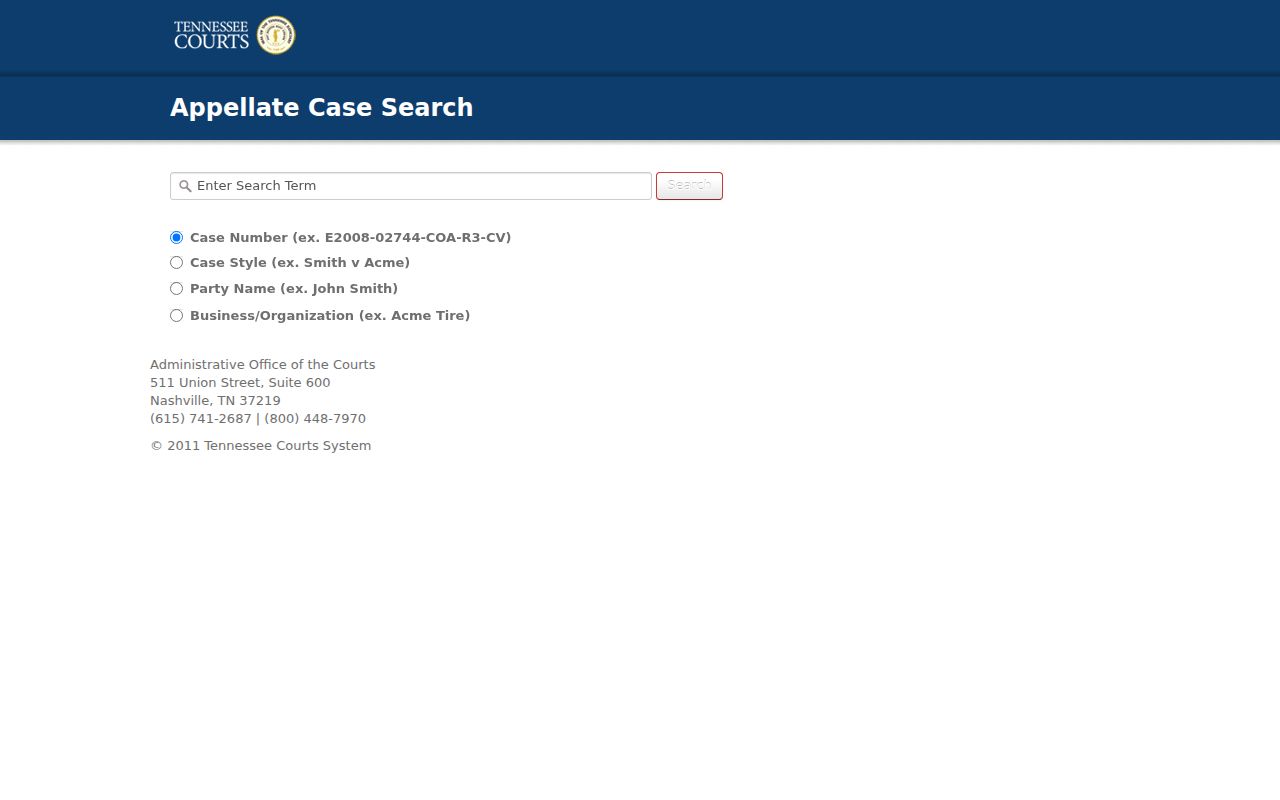
Use the fields below only for an appealed matter. A result can show the originating county and court, appellate judges, counsel, events, orders, opinions, disposition, and mandate. It does not supply an Overton jail profile or guarantee access to trial exhibits.
| Field label | Type | Required | Notes |
|---|---|---|---|
| Case Number | Text | Alternative | Use the appellate number |
| Case Style | Text | Alternative | Search the party style |
| Party Name | Text | Alternative | Search a named party |
| Business/Organization | Text | Optional | Party filter |
| Court | Dropdown | Optional | Select an appellate court |
| Case Type | Dropdown | Optional | Options depend on the court |
| Status/date range | Filters | Optional | Narrow the result set |
Inside an Overton County Case File
A court file documents the prosecution as it changed over time. It can show the charging instrument, scheduled events, bond action, motions, a plea or trial result, the judgment, and the sentence. Those fields answer a different question from an arrest report, which records an officer's custody decision and alleged charges at that point. The final court judgment controls the legal disposition.
| Case number and court | Identifies the file, division, and custodian. |
|---|---|
| Charging document | Shows the indictment, information, warrant, or other filed accusation and cited statute. |
| Docket entries | Chronological record of filings, appearances, motions, and court action. |
| Hearing dates | Lists scheduled events and may show continuances or completed appearances. |
| Disposition and judgment | Records conviction, dismissal, nolle prosequi, acquittal, retirement, diversion, or another outcome. |
| Sentence and conditions | May state confinement, probation, fines, costs, restitution, and post-judgment terms. |
Protected identifiers and victim or juvenile data may be redacted. Availability can also vary by age and format. Ask the clerk which entries are in the active electronic index and which need archive retrieval.
Certified Overton Case Dispositions
A search result or verbal status is useful for orientation. A certified disposition is stronger when a person needs to prove how an Overton County charge ended. Ask the clerk for the judgment or disposition tied to the exact case number, and state that certification is needed. If several counts appear, check the outcome of each count rather than relying on the broad case label.
Terms matter. Nolle prosequi means the prosecution declined to proceed on that charge at that time. A dismissal ends the cited charge through court action. A bind-over sends a felony matter onward after the preliminary stage. A capias is a court command associated with taking a person into custody, often after a missed appearance or unmet court duty. None of those terms should be silently converted into “convicted.”
If a TBI history and the clerk judgment conflict, obtain the certified local record first. The court clerk corrects its file. A repository issue follows TBI's dispute route with the judgment attached. That division keeps the record correction aimed at the office that controls the disputed field.
How a Criminal Case Moves
An Overton County felony matter can change form as it crosses court stages. Charges alleged at booking can be amended before filing, altered by grand-jury action, resolved by plea, or rejected. The docket is the timeline that shows those shifts. It also records whether a scheduled event occurred, moved, or led to a ruling.
Case flow: Charges Filed → Arraignment → Pretrial → Plea or Trial → Disposition → Sentencing
General Sessions may be part of the path before Criminal/Circuit Court. The 13th Judicial District prosecutor decides and litigates charges, while the clerk keeps the public court file. The prosecutor is not the public docket custodian. A later appeal creates a separate higher-court chronology without replacing the trial judgment.
Note: A filed count, a disposed count, and a person are different units, so court workload totals should not be read as defendant totals.
Overton Appeal Records in PCH
Once an Overton criminal case reaches the Court of Criminal Appeals or another Tennessee appellate court, Public Case History becomes useful. Search by appellate number when possible. A party or style search is the fallback. Confirm that the result names Overton as the originating county and matches the trial court before using its events.
The appellate file may include briefs, orders, an opinion, disposition, and mandate when those items are public electronically. The mandate is the appellate court's formal direction returning authority after review. It does not itself reproduce every motion, exhibit, or transcript from the trial record. Obtain the local judgment from the Circuit Court Clerk and the appellate action from Public Case History to see both layers.
Fiscal-year data also adds context without describing any one case. Tennessee's court report recorded 333 criminal counts filed and 416 disposed in Overton during FY2024-25, with 324 counts pending at year end. Those figures are counts, not unique cases or people, and the filed and disposed groups are not the same cohort.
Federal Cases Outside Overton Courts
A federal prosecution arising in Overton County does not sit in the county clerk's criminal docket. The U.S. District Court for the Middle District of Tennessee serves the county through its Northeastern Division. Federal dockets use PACER and the district's CM/ECF system, while the county clerk continues to control Tennessee state-court matters.
The Middle District of Tennessee site marks this separate court channel.
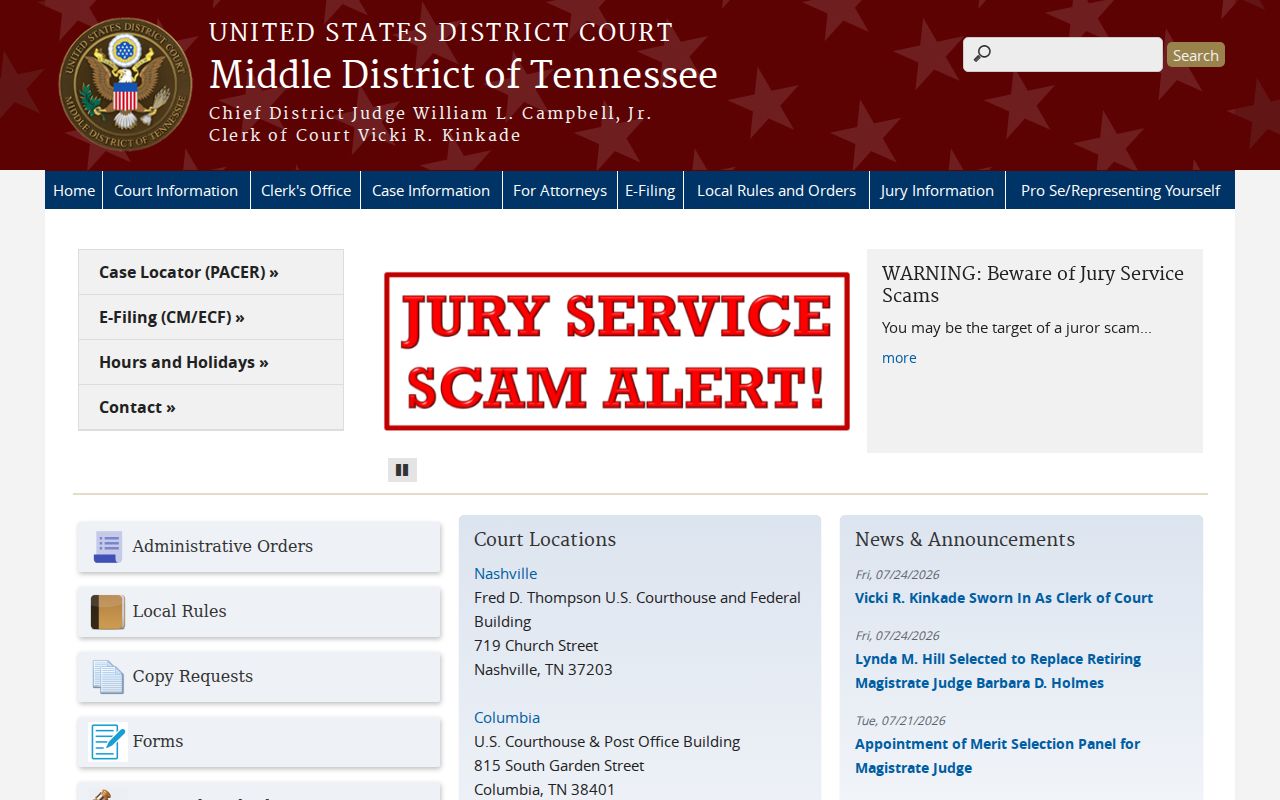
Use the federal source only when the case was filed under United States jurisdiction. An FBI identity-history summary is also not a docket. It is a fingerprint-based self-review product. Keeping county, appellate, and federal sources distinct prevents a missing result in one system from being mistaken for proof that no case exists.
Case Record Access & Restrictions
The Tennessee Public Records Act supports access to identifiable public records, but it does not make every part of every Overton County case open. Tenn. Code Ann. § 10-7-503 addresses inspection and custodian procedures, while § 10-7-504 covers confidential material and exceptions. Tennessee custodians may require proof that a requester is a Tennessee citizen. A narrow request for an existing docket, judgment, or order works better than asking staff to compile a new history.
Pending criminal material can also be restricted under Tennessee Rule of Criminal Procedure 16 and the Appman line of cases. Juvenile records, sealed filings, expunged records, victim-identifying data for protected offenses, medical information, Social Security numbers, and other protected identifiers may be withheld or redacted. A blank online result can therefore mean the matter is local-only, archived, sealed, expunged, misidentified, or outside that portal's court level.
When access is limited: Ask the clerk to identify the legal basis for each withheld category, request separable public portions, and narrow the record description or date range.
For a broad view of how arrest, court, and state repository records differ, return to the Overton County criminal history overview. Court-specific proof should still come from the clerk that holds the original file.